Best Baby Bassinets 2026: Bedside Sleepers, Smart Bassinets & Portable Options
Safe sleep options for the first 6 months

Halo BassiNest Soothing Swivel Sleeper 3.0S
Under $500
The Halo BassiNest Swivel Sleeper's 360° rotation and lowering wall transform nighttime feeds from an exhausting production into a simple, half-asleep motion.
The Halo BassiNest has been a category leader for years, and research and owner reviews confirm it deserves the position. The 360° swivel is the defining feature, rotate the bassinet over your bed for feeding, then rotate it back for sleep. No standing up, no transferring baby across your body.
The side wall lowers to within an inch of your mattress, letting you see, touch, and soothe baby without sitting up. Owners frequently call this the single most important feature: "I could roll over, pat her back, and fall back asleep. Game changer for those 4 AM wake-ups."
The base slides under most beds (requires 4" clearance), bringing baby within arm's reach. Six height positions accommodate beds from low platforms to pillow-tops. Owners with different bed heights report finding a workable position.
Built-in soothing features include gentle vibration, white noise sounds, and an amber nightlight (doesn't disrupt melatonin like blue light). Owners find these helpful, though none replaces actual feeding or holding.
The main drawback is portability, at 32 lbs with no wheels or folding, this is a bedroom-only bassinet. You'll want something different for living room naps. Assembly takes about 20 minutes and requires no tools.
The mesh sides provide airflow and visibility, meeting all AAP safe sleep guidelines. The mattress is appropriately firm, and the fitted sheets are purpose-designed (don't use crib sheets).
Who It's For
- Parents prioritizing nighttime convenience
- Breastfeeding moms wanting easy access
- C-section recovery (minimizes movement)
- Those with space for a dedicated bedroom bassinet
Skip This If
- You need portability room-to-room
- Floor space is severely limited
- Budget is under $200
- You prefer baby at arm's length (some parents do)
Why We Love It
- 360° swivel brings baby right to you
- Lowering wall enables easy soothing without standing
- Height adjusts to match any bed
- Built-in soothing (vibration, sounds, light)
- Meets all safe sleep standards
What's Not Ideal
- •Not portable, stays in bedroom
- •Takes up significant floor space
- •Premium pricing for the category
- •Some wobble when swiveling (normal)
Key Specs
The AAP recommends room-sharing (not bed-sharing) for at least the first 6 months, and a bassinet makes that practical without sacrificing your entire bedroom to a full crib. After researching 14 bassinets against safety certifications and thousands of verified owner reviews, we're confident the Halo BassiNest Swivel Sleeper is the best bassinet for most parents, the swivel design and lowering wall make nighttime feeds almost effortless, which matters enormously when you're operating on 3 hours of broken sleep.
But if budget allows, the SNOO Smart Sleeper lives up to the hype. Owner reviews consistently report the automated soothing adds sleep time for most babies. The over $1,000 price is steep, but the rental option ($159/month) and strong resale market make it more accessible than the sticker suggests.
For budget-conscious families, the Baby Delight Beside Me Dreamer delivers bedside convenience at a fraction of the cost, proving you don't need to spend a fortune for safe, practical sleep space.
We prioritized safety certifications and CPSC recall records, compared convenience features against manufacturer specs (can you reach baby one-handed?), checked mattress firmness claims, and read through thousands of verified owner reviews to see how each bassinet performed during those chaotic first months.
Our Top Picks at a Glance
Halo BassiNest Soothing Swivel Sleeper 3.0S
Under $500
SNOO Smart Sleeper Bassinet
$1,000+ (or rent monthly)
Baby Delight Beside Me Dreamer
Under $250
Graco SmartSense Soothing Bassinet
Under $500
Graco DreamMore Bedside & Portable Bassinet
Under $250
Click any pick to see current price on Amazon
How We Research
Our recommendations combine independent research with owner-review research, not a paid lab or sponsored panel. For every bassinet we confirm CPSC compliance and JPMA certification where applicable, check the CPSC recall database, and align our guidance with AAP safe-sleep recommendations, including the requirement for firm, flat sleep surfaces. We compare manufacturer specifications side by side, including mattress firmness claims, height adjustment ranges, weight limits, portability, and any motorized or vibrating features. We then read through thousands of verified owner reviews to surface real-world patterns: how easily parents reach baby one-handed, how stable each bassinet feels in daily use, and how loud or helpful the soothing features actually are. We weigh how each bassinet fits beside a real bed. We earn a commission if you buy through our links, at no extra cost to you, and that never decides our rankings.
Sources Reviewed
- AAP safe-sleep guidelines
- CPSC bassinet and cradle safety standards (16 CFR 1218)
- JPMA certification records
- Manufacturer specifications and recall records
What We Looked For
- JPMA certification and CPSC compliance verified for all models
- Mattress firmness per manufacturer specs (AAP recommends firm, flat surfaces)
- One-handed baby access from bed across mattress heights
- Assembly time and tool requirements per owner reports
- Portability: weight, wheel function, folding mechanism
- Noise of motorized or vibrating features per specs and owner reports
- Stability in daily use per owner reports
More Top Picks
SNOO Smart Sleeper Bassinet
$1,000+ (or rent monthly)
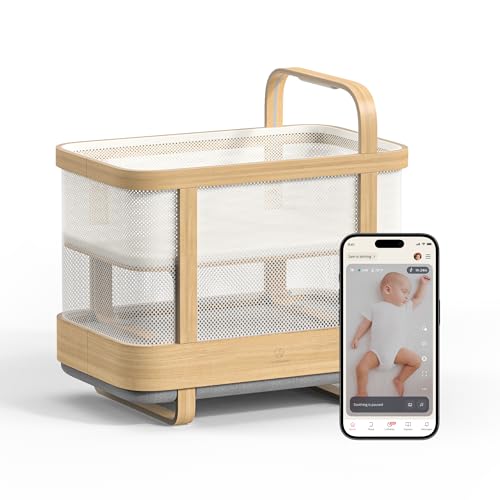
The SNOO Smart Sleeper is the most effective sleep aid in this lineup, with owners frequently reporting 1-2 extra hours of sleep, but the premium price makes it a luxury choice unless you rent.
The SNOO is the Tesla of bassinets: expensive, technologically impressive, and genuinely effective at its core function. Developed by Dr. Harvey Karp (Happiest Baby on the Block), it uses responsive motion and sound to soothe babies back to sleep automatically.
Here's how it works: when baby fusses, built-in microphones detect the sound and respond with gentle rocking and white noise. If crying continues, intensity gradually increases through five levels before alerting parents. Owners commonly report the SNOO soothes babies back to sleep without parent intervention a majority of the time.
The sleep gains are reported as real. Owners commonly report 1-2 additional hours of sleep per night compared to their previous bassinet. At 3 AM, that hour feels like gold. Many owners say they would buy it again, about the strongest endorsement possible.
The built-in swaddle clips secure baby on their back, preventing the dangerous rolling that causes some SIDS deaths. Pediatric sleep guidance supports this kind of safety feature, and it is among the safest swaddling systems available.
The price is the obvious barrier. At over $1,000 new, it costs 5-7x more than traditional bassinets. However: rentals run $159/month (less than many sleep training services), used units sell for under $1,000 (use 6 months, sell for half back), and some insurance/HSA plans cover it for reflux or sleep issues.
The SNOO won't work for every baby, about 20% of owners report minimal benefit. That's why we recommend renting first to test before buying.
Who It's For
- Parents prioritizing maximum sleep
- Those willing to rent before buying
- Babies with colic or reflux (motion helps)
- Parents returning to demanding jobs early
- Those who will resell to recoup costs
Skip This If
- Budget is a primary concern
- You're comfortable with some crying
- You prefer traditional swaddling methods
- You want easy bedside access (no wall lowering)
Why We Love It
- Responsive motion genuinely helps babies sleep longer
- Built-in swaddle is the safest available
- App control and sleep tracking
- Rental and resale options reduce effective cost
- Developed by respected pediatrician
What's Not Ideal
- •Extremely expensive new (over $1,000)
- •Not effective for all babies (~20% see minimal benefit)
- •Requires proprietary swaddle system
- •Baby may become dependent on motion
- •No side-lowering for easy access
Key Specs
Baby Delight Beside Me Dreamer
Under $250
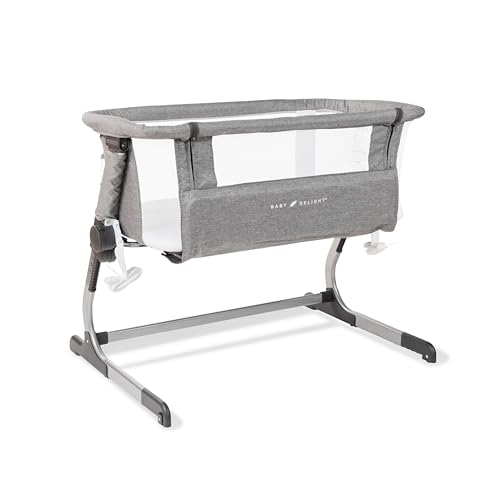
The Baby Delight Beside Me Dreamer delivers the core bedside sleeper features, lowering wall, adjustable height, portability, at a price that makes the premium competition look overpriced.
The Baby Delight Beside Me Dreamer is the budget bassinet that makes owners question why anyone pays more. At under $250, it includes features found on pricier bedside sleepers: adjustable height, side wall that lowers, wheels for portability, and compact folding for storage.
The side wall lowers similarly to the Halo, letting you reach baby easily from bed. Six height positions accommodate different beds, though the range isn't quite as broad as the Halo. For standard bed heights (18-24"), it works fine.
Portability is a genuine advantage, light weight (15 lbs), lockable wheels, and flat folding mean you can move it room to room or store it between kids. Owners appreciate this flexibility; many keep the Baby Delight in the living room during the day.
Build quality is where you feel the price difference. The frame feels less substantial than premium bassinets, though owners report it stays stable in daily use. The mesh sides are thinner, and the mattress, while adequately firm, lacks the cushioned feel of pricier options.
The lack of built-in soothing features (vibration, sounds) is notable. If those matter to you, look at the Graco or spend more on the Halo. But many owners report they didn't use soothing features much anyway, when baby cries, baby wants feeding or holding, not vibration.
For under $250, the Baby Delight proves that safe, convenient bedside sleeping doesn't require a premium budget.
Who It's For
- Budget-conscious families
- Those wanting portability
- Second-time parents who know what features they actually use
- Anyone skeptical of premium bassinet pricing
Skip This If
- Built-in soothing features are important
- You want premium aesthetics
- Your bed is unusually high or low
- You prefer heavier, more stable construction
Why We Love It
- Under $120 with premium features
- Side wall lowers for easy access
- Truly portable with wheels and folding
- Six height positions
- Meets all safety standards
What's Not Ideal
- •Flimsier construction than premium options
- •No soothing features
- •Narrower height adjustment range
- •Less attractive aesthetics
Key Specs

Graco SmartSense Soothing Bassinet
Under $500
The Graco SmartSense brings cry-responsive soothing, the headline SNOO feature, to a bassinet that costs a fraction of the price.
The SmartSense is Graco's answer to the smart bassinet category. According to Graco, it listens for your baby's cries and responds on its own with combinations of white noise, vibration, and gentle rocking and swaying motions, so you are not getting up to restart a timer.
Graco says the bassinet offers thousands of sound and motion combinations, which matters because different babies settle to different rhythms. It can be used with or without a swaddle, so it does not lock you into one sleep routine.
What it does not do is replace a full smart-sleeper system. It has no wearable-style swaddle clip and no rental option, and like most motion bassinets it is a stationary piece of furniture rather than something you fold into a travel bag.
At under $500, the SmartSense sits between basic bassinets and the SNOO. We recommend it for parents who want automatic, cry-triggered soothing but cannot justify SNOO pricing.
Who It's For
- Parents wanting automatic soothing on a budget
- Those who find SNOO too expensive
- Babies who settle with motion and white noise
Skip This If
- You need a bassinet that travels
- You prefer simple, low-tech solutions
- Budget is under $300
Why We Love It
- Responds to crying automatically
- Sound and motion combined, with many combinations
- Works with or without a swaddle
- A fraction of the SNOO price
What's Not Ideal
- •Not portable
- •Motion may not suit every baby
- •Pricier than basic bassinets
Key Specs

Graco DreamMore Bedside & Portable Bassinet
Under $250
The Graco DreamMore is a budget bedside bassinet that folds into its own travel bag, so the same bassinet covers your bedroom and trips to the grandparents.
The DreamMore is built around portability. Graco says it folds with one hand, stands on its own when folded, and packs into the included carry bag, which makes it a practical pick for families who travel or split time between homes.
It gives baby a roomy, firm, flat sleep surface, the part that matters most for safe sleep, and comes with a machine-washable sheet. A large storage organizer with a divider keeps diapers, wipes, and burp cloths within reach at night.
There is no motion, sound, or cry detection here. If you want automatic soothing, look at the SmartSense or the SNOO above. If you want a simple, safe bedside sleep space that also travels, the DreamMore covers that for well under $150.
Who It's For
- Families who travel or split time between homes
- Budget-conscious parents
- Anyone who wants one bassinet for bedroom and trips
Skip This If
- You want automatic soothing
- You will never move the bassinet
Why We Love It
- One-hand fold and travel bag included
- Firm, flat sleep surface
- Storage organizer for night supplies
- Well under $150
What's Not Ideal
- •No motion or sound soothing
- •Simpler than smart bassinets
Key Specs
Spec Comparison
| Feature | OverallHalo BassiNest | Smart BassinetSNOO Smart | BudgetBaby Delight | Motion BassinetGraco SmartSense | Portable BudgetGraco DreamMore |
|---|---|---|---|---|---|
| Price | Under $500 | $1,000+ (or rent monthly) | Under $250 | Under $500 | Under $250 |
| Weight | 32 lbs | 38 lbs | 15 lbs | , | , |
| Dimensions | 34" L x 17" W x 34-42" H | 35" L x 17" W x 32" H | 36" L x 22" W x 32" H | , | , |
| Weight Limit | 20 lbs | 25 lbs | 20 lbs | , | , |
| Age Limit | 5 months or mobile | 6 months or rolling | 5 months or mobile | , | , |
| Adjustable Height | Yes - 6 positions | Leg extensions available | Yes - 6 positions | , | , |
| Wall Lowering | Yes - one side | No | Yes - one side | , | , |
| Buy | Buy | Buy | Buy | Buy |
What We Didn't Recommend
We researched these products but ultimately couldn't recommend them for the reasons below.
Chicco Close to You Bedside Bassinet
Solid bedside option (under $250) with lowering wall and adjustable height, but smaller sleep surface and less stable base than the Halo. Good if Halo is unavailable.
Arm's Reach Versatile Co-Sleeper
Pioneer of the bedside bassinet category (under $250), but dated design lacks features of newer competitors. The lowering wall works well, but overall value trails newer options.
BabyLetto Luna Bassinet
Beautiful mid-century modern design (under $250), but no lowering wall, adjustable height, or soothing features. Style over function at this price point.
Halo BassiNest Premiere Series
Upgraded materials and design (under $500) over the standard Swivel Sleeper, but not enough improvement to justify more. The standard model is the better value.
Fisher-Price Soothing Motions Bassinet
Motion and sounds at a budget price (under $250), but swaying motion concerns some safe sleep advocates. Also lacks height adjustment and bedside features.
Buying Guide
Types of Bassinets
Bedside Sleepers (Halo, Baby Delight): Feature walls that lower to your mattress level, height adjustment, and designs that tuck next to your bed. Best for breastfeeding moms and those wanting closest access.
Smart Bassinets (SNOO): Use technology to automatically soothe babies back to sleep. Expensive but potentially life-changing for sleep-deprived parents. Rental options reduce risk.
Motion Bassinets (Graco SmartSense): Offer rocking and swaying, and some now respond to crying. Baby gets motion triggered by crying.
Portable (Graco DreamMore): Emphasize folding and travel. Better for room-to-room use than true bedside sleeping.
Basic Bassinets: Simple, safe sleep spaces without bells and whistles. Fine for babies who sleep well and parents who don't need extra features.
Safety Requirements
Every bassinet in our recommendations meets these non-negotiable requirements:
Firm, Flat Mattress: AAP recommends firm surfaces that don't indent when baby lies down. Never add padding, toppers, or soft bedding.
CPSC Compliance: All bassinets sold in the US must meet Consumer Product Safety Commission standards as of 2022. Verify before buying used.
JPMA Certification: Voluntary certification indicating third-party safety testing. All our top picks are JPMA certified.
Nothing in the Bassinet: Only baby and a fitted sheet. No blankets, pillows, toys, bumpers, or positioners, regardless of marketing claims.
Weight/Age Limits: Stop using when baby exceeds limits, can roll over, push up on hands and knees, or outgrows the space, whichever comes first.
Check Recalls: Before buying used, verify the model hasn't been recalled at cpsc.gov.
Bedside vs. Freestanding
Bedside Bassinets (Halo, Baby Delight, Chicco) position baby within arm's reach: - Pros: Easy nighttime feeds, can soothe without standing, follows AAP room-sharing guidance - Cons: Takes bedroom space, harder to move, some parents prefer more separation
Freestanding Bassinets (Graco, basic models) work anywhere: - Pros: Room-to-room flexibility, often more affordable, some find baby sleeps better with slight separation - Cons: Harder to access quickly, may discourage room-sharing
Our Recommendation: If you're breastfeeding or recovering from C-section, start with a bedside sleeper. The convenience during those exhausting early weeks is worth it. You can always move it further from the bed later.
Do You Need a Smart Bassinet?
Smart bassinets (SNOO) cost 5-10x more than basic options. Here's how to decide:
Consider SNOO/Smart Bassinets If: - Sleep deprivation is severely impacting your health or relationship - You or partner returns to demanding work early - Baby has colic, reflux, or is exceptionally fussy - Budget allows (or you'll rent/resell) - You've tried everything else
Skip Smart Bassinets If: - Baby already sleeps reasonably well - You're comfortable with some night waking (it's developmentally normal) - Budget is tight (even with rental) - You dislike dependency on technology - You prefer handling sleep training yourself
The Rental Option: SNOO rentals (monthly) let you test without an over-$1,000 commitment. If it works, great. If not, return it. This is the smartest approach for uncertain parents.
How Long Will Baby Use a Bassinet?
Most babies transition out of bassinets between 3-6 months due to:
Weight Limits: Most bassinets support 15-25 lbs. Large babies may hit this earlier.
Mobility: Once baby rolls over or pushes up, bassinet isn't safe regardless of weight.
Size: Long or large babies may simply outgrow the sleep space before hitting weight limits.
Sleep Needs: Older babies move more during sleep and may bump into sides frequently.
Planning for This: - Consider a bassinet an investment for 4-6 months, not years - Factor this into cost-per-use calculations (SNOO at over $1,000 for 6 months = $250/month) - Have a crib ready for transition around 4 months - Some babies transition to crib earlier with no issues, don't force bassinet use if baby sleeps better in crib
Frequently Asked Questions
Most babies outgrow bassinets by 4-6 months or when they reach the weight limit (typically 15-25 lbs), can roll over, can push up on hands and knees, or are simply too long for the sleep space, whichever comes first. Some larger babies outgrow them by 3 months. Watch for signs your baby is ready to transition to a crib: consistently bumping the sides, seeming cramped, or any mobility milestones.
Update History
- 2026:Added the Graco SmartSense as the motion pick. Updated SNOO rental pricing and resale value data.
- 2026:Updated safety certifications for all models.
- 2026:Initial publication covering 14 bassinets researched against safety standards, manufacturer specs, and verified owner reviews.
Related Resources
Related Articles
Cradlewise smart bassinet review
The most capable smart bassinet, reviewed with the safe sleep caveat stated plainly.
Evolur Aurora crib review
Skipping the bassinet stage and starting in a full-size crib.
Best Cribs 2026
For when baby outgrows the bassinet
Best Crib Mattresses 2026
Safe sleep surface options
Best Baby Swaddles 2026
Help baby sleep better
Safe Sleep Guide for Newborns
AAP guidelines explained
When to Transition Baby to Crib
Signs baby is ready
As an Amazon Associate, ParentCalc earns from qualifying purchases. Prices and availability are subject to change. We independently select products and may receive a commission when you buy through our links, at no extra cost to you. This helps support our free calculators and guides.