Sponsored: Retrospec paid for this review and sent us the bike. Every opinion here is ours. We also earn a commission if you buy through the links on this page, at no extra cost to you.
Hands-on reviewRetrospec Koda Plus 16" review: our daughter's first pedal bike
We built it in half an hour, put our tall 3.5 year old on it straight off her balance bike, and walked (and partly carried) it around the block. Here is how it went, from a parent who has raced road bikes for most of his life.
By Glen Meade, founder of ParentCalc · Published 2026
The short verdict
5 out of 5
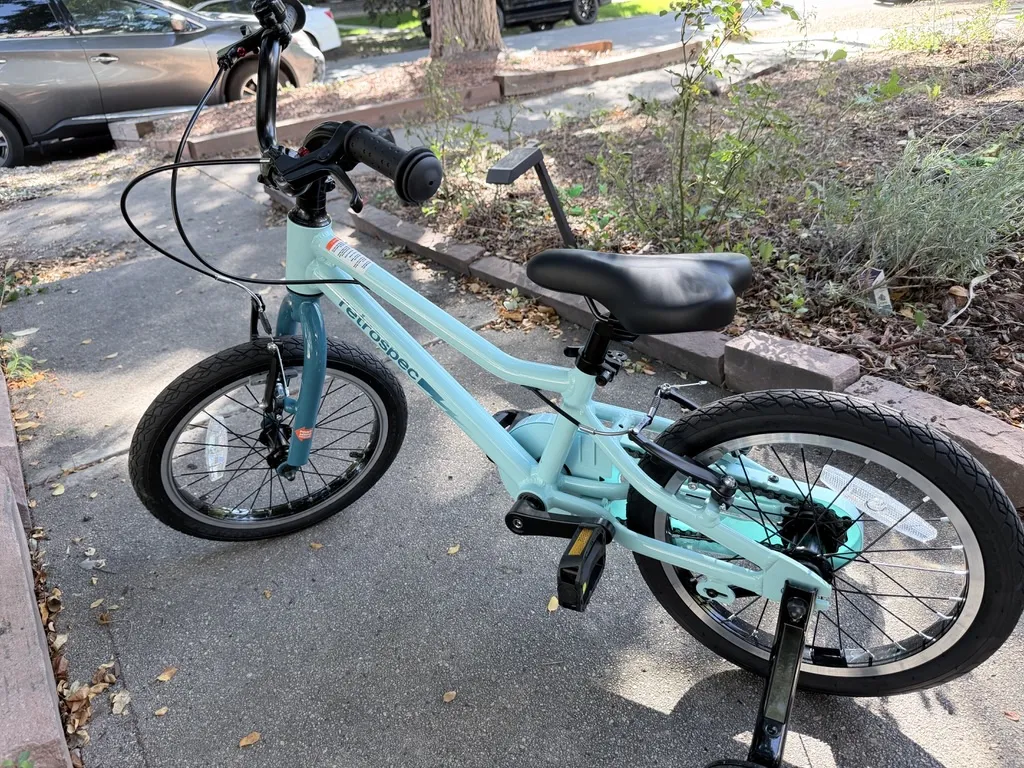
The Koda Plus 16 is a sturdy, well-made first pedal bike that goes together easily and gave our daughter a good first experience moving up from a balance bike. It is similar in quality to Trek's kids bikes, and as someone who spends free weekends on a carbon road bike in the mountains, I would not hesitate to buy it for a child learning to ride. The one fiddly part of the build was threading the pedals into the crank arms.
Retrospec is a ParentCalc partner. This link runs through AvantLink, and we earn a commission on purchases.
What we liked and what we did not
Pros
- Sturdy aluminum frame with good materials and finish
- Easy to put together: about 30 minutes, and the essential tools are in the box
- Two ways to stop: hand brake levers plus a coaster (pedal backward) brake
- Grown-up construction details: threadless steering, internal cable routing, aluminum levers with tool-free reach adjustment
- Low 19" minimum seat height let a tall 3.5 year old start on a bike sized for ages 4 to 6
Cons
- Threading the pedals into the crank arms was stiff and took some care
- Costs $80 more than the steel Koda 16, so the value depends on how much a lighter frame and better brakes matter to you
- Retrospec does not publish a weight, so you cannot compare it on paper with woom or Trek
Who tested it
Two of us. The rider is my daughter, who was three and a half when the bike arrived and is tall for her age. Before this she rode the Retrospec Cub balance bike, so she already knew how to steer, scoot and coast. The Koda Plus is her first bike with pedals.
The mechanic is me. I have raced road bikes for a lot of my life and still spend many free weekends riding a carbon road bike in the Colorado mountains, so I have built, adjusted and broken more bikes than I can count. That matters for a review like this in one specific way: I know what cheap bike parts look and feel like when you put a wrench on them, and I know which shortcuts on a kids bike actually matter.
Unboxing and assembly: about 30 minutes
The bike arrives mostly built. The rear wheel, drivetrain, brakes and cables are already in place, so assembly is the same short list you get with most boxed kids bikes: turn the fork to face forward, fit the front wheel, attach and center the handlebar in the stem, set the saddle height with the quick release, and thread on the pedals. Setup took us about 30 minutes from cutting the straps to a rideable bike.
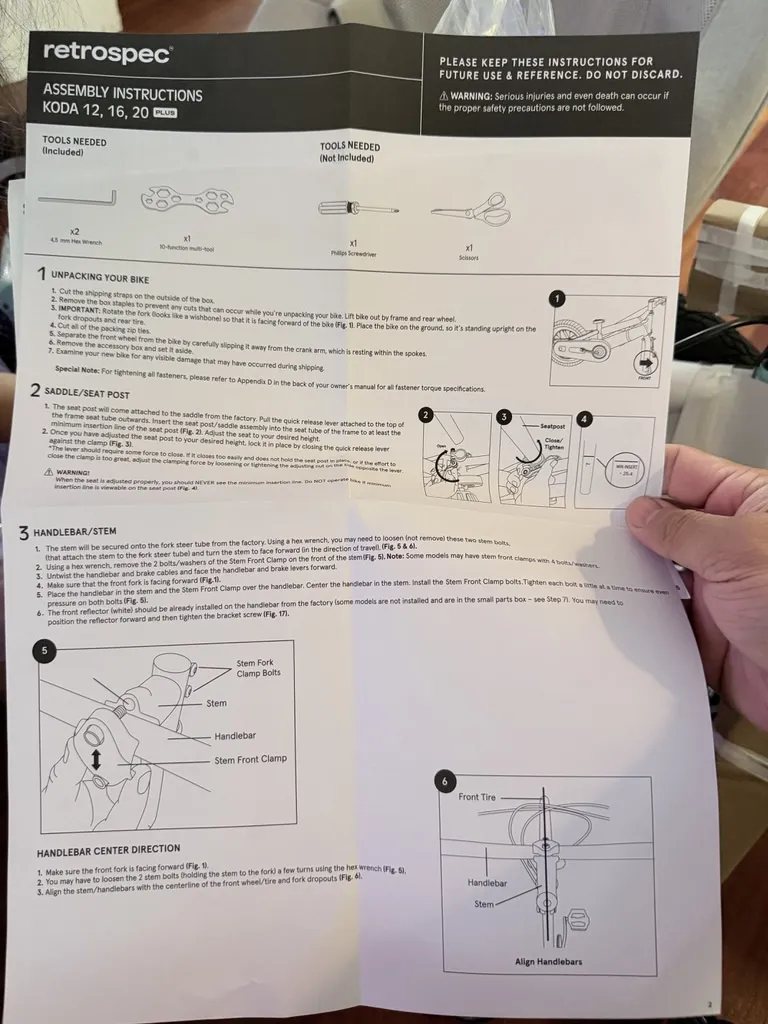
The tools you need to put the bike together come in the box: two 4.5 mm hex wrenches and a 10-function multi-tool. The instruction sheet also lists a Phillips screwdriver and scissors (for the packing zip ties) as not included, and you will want both on hand. The printed steps are clear and illustrated, including a section on lining the handlebar up with the front wheel, which is the step most first-time builders get slightly wrong.
The one tough part: pedal threads
The only thing that gave us any trouble was threading the pedals into the crank arms. The threads were stiff, and it took some patience before both pedals went in cleanly. We got there, and it is a common sticking point on new bikes, but it is worth knowing before you start so you do not force it. What helps:
- Match the pedals to the sides. Pedals are marked R and L. The right pedal tightens clockwise. The left pedal is reverse-threaded and tightens counterclockwise. A left pedal forced into the right crank arm (or the wrong direction) is the most common way to ruin a crank on day one.
- Start every pedal by hand. Turn it in with your fingers for the first few turns. If it will not start by hand, back it out and try again straight. Only reach for the wrench once the threads have caught.
- A little grease goes a long way. A dab of bike grease on the pedal threads makes them go in smoother now and come out easier later, when you move the pedals to the next bike or hand this one down.
- Check the torque. Retrospec lists fastener torque specifications in the back of the owner's manual. Pedals, stem bolts and axle nuts are the ones to get right.
Build quality through a racer's eyes
The bike is sturdy, the materials are good, and it went together easily. It feels like a scaled-down real bike rather than a toy with a chain. I would put it in the same quality bracket as Trek's kids bikes, no doubt.
A few specific things back that up, and they are the details I look at first on any bike:
- An aluminum frame. The standard Koda uses high-tensile steel. The Plus uses aluminum alloy, which is what you want on a bike your child has to push, lift and steer. Retrospec does not publish a weight for either model, so we cannot give you a number, but aluminum is the main reason to pay the extra.
- Threadless steering. The stem clamps onto the fork steerer the way it does on adult road and mountain bikes. It holds adjustment better than the old quill-style stems common on budget kids bikes.
- Internal cable routing. Brake cables run inside the frame for part of their path. It looks cleaner and gives small hands and feet fewer cables to snag.
- Aluminum brake levers with tool-free reach adjustment. This is the one I care about most. A child cannot use a brake lever they cannot reach. Being able to bring the levers closer to the bar without tools means you can set them for a three-year-old hand now and move them out as she grows.
Brakes: hand levers and a coaster brake
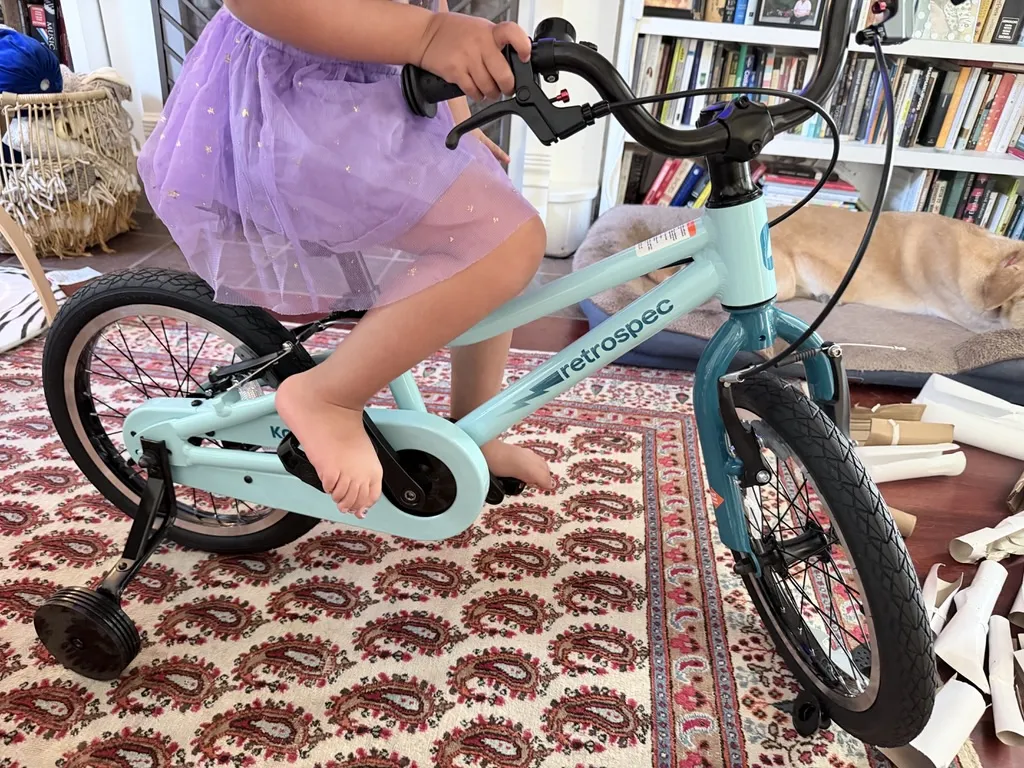
The Koda Plus gives a child two ways to stop. The hand levers operate V-brakes (Retrospec specifies front and rear), and there is a rear coaster brake, so pedaling backward stops the bike too.
For a first pedal bike I like having both. Pedaling backward is the stop most three and four year olds find on their own, which makes the first rides less scary. The hand levers teach the habit she will use on every bike after this one, including any road or mountain bike she rides as a teenager, none of which will have a coaster brake. Some cycling parents prefer no coaster brake at all, because it can make it harder to reposition the pedals to start off. It did not get in our way on the first ride, but it is a real trade-off and worth knowing about.
The first ride: from balance bike to pedals
Coming from the balance bike, the Koda Plus was a good first pedal bike experience. She already had the balance and steering from the Cub, so the new part was pedaling, and she was getting the hang of it by the end of the ride.
To be honest about it: yes, I carried the bike around half of the block on the way home. That is what a first ride on pedals looks like at three and a half. Little legs tire, and the novelty wears off before the walk home does. It is not a knock on the bike. If anything, the fact that I did not mind carrying it says something about how manageable it is.
If you are moving a child from a balance bike, a few things we would pass on:
- Set the saddle low for the first rides. Low enough that both feet can reach the ground. A child who can put a foot down will try things a child perched on tiptoe will not.
- Plan a short loop. Around the block is plenty. End on a success rather than a meltdown, and expect to carry the bike some of the way.
- Decide about training wheels based on the balance bike. Kids who already balance often do fine without them. The Koda Plus includes removable training wheels, so you can start with them and take them off once pedaling clicks.
- Helmet on from the first ride. Make it part of getting on the bike, not a separate negotiation. Our kids bike safety guide covers fit.
Sizing: is a 16" right for a 3 year old?
Retrospec rates the Koda Plus 16 for ages 4 to 6, and our tester was three and a half. It worked because she is tall and because the seat on this bike goes unusually low for a 16-inch wheel: 19 inches at the bottom of its range, up to 24 inches. That low minimum is why a tall three-year-old can start on a bike she will not outgrow for a couple of years.
Go by inseam, not age. For a first pedal bike your child should be able to sit on the saddle and reach the ground with the balls of both feet. If your child's inseam is close to or above the 19-inch minimum, the 16-inch Koda Plus is worth a look even before their fourth birthday. If not, the Koda Plus 12" (seat 16 to 19 inches, ages 2 to 3) is the size down. Our kids bike size calculator does the math from height and inseam.
Specifications
| Wheel size | 16" |
|---|---|
| Ages (per Retrospec) | 4-6 years |
| Seat height | 19"-24" |
| Frame | Aluminum alloy |
| Brakes | Front + rear hand V-brakes + rear coaster brake |
| Gearing | Single speed |
| Training wheels | Included, removable |
| Rider weight limit | 80 lbs |
| Steering and cables | Threadless steering, internal cable routing |
| Colors | Robins Egg, Matte Black, Rose, Iguana |
| List price | Under $250 |
Specifications from Retrospec's product listing. Retrospec does not publish a bike weight.
Koda Plus 16 vs Koda 16 vs woom and Trek
| Koda Plus 16" | Koda 16" | |
|---|---|---|
| Price | Under $250 | Under $250 |
| Frame | Aluminum alloy | High-tensile steel |
| Brakes | Front + rear hand V-brakes + rear coaster brake | Hand V-brake + rear coaster brake |
| Seat height | 19"-24" | 18.5"-23" |
| Steering | Threadless | Not listed |
| Training wheels | Included, removable | Included, removable |
| Rider limit | 80 lbs | 80 lbs |
Koda Plus vs the standard Koda. The Koda 16" at Under $250 is the budget choice, and a perfectly reasonable one if the bike will see occasional weekend use. The $80 step up to the Plus buys the aluminum frame, the dual hand brakes with reach-adjustable aluminum levers, threadless steering and a slightly lower seat. For a child who will ride often, or a small child who needs every bit of help handling the bike, the Plus is the one we would pick.
Koda Plus vs woom and Trek. A woom GO 3 costs about twice as much, is famously light, and has no coaster brake. It is the bike cycling families buy when budget is not the question. Trek's kids bikes are the bike-shop benchmark, and after building the Koda Plus I would put it in the same quality class. If you want a real, well-made first pedal bike and would rather not spend woom money, the Koda Plus is the one to look at.
Who should buy the Koda Plus 16
- Kids moving from a balance bike to their first pedal bike, roughly ages 4 to 6, or a tall 3
- Parents who want bike-shop build quality without paying bike-shop prices
- Families who want hand brakes from day one, with a coaster brake as backup
- Anyone who plans to hand the bike down to a younger sibling
Who should look elsewhere
- Families on the tightest budget: the steel Koda 16 does the same basic job for less
- Cycling parents who specifically want a freewheel (no coaster brake) 16-inch bike
- Kids who cannot yet reach the ground from a 19-inch seat, who will fit the 12-inch size better
Final verdict: 5 out of 5
The Koda Plus 16 did exactly what a first pedal bike needs to do. It went together in about half an hour with the tools in the box, it is sturdy and made of good materials, it stops two ways, and it took our daughter from balance bike to pedaling on day one, even if I did carry it for part of the walk home. I have spent most of my life on road bikes and I would not hesitate to buy this for a kid learning to ride.

Retrospec Koda Plus 16" Kids Bike
Under $250 · 4-6 years · 4 colors
Also worth adding: a Retrospec Scout kids helmet (Under $25). For older kids, the Koda Plus 20" is the next size up.
Frequently asked questions
Is the Retrospec Koda Plus 16 good for a 3 year old?
For a tall 3 year old, yes. Retrospec rates the Koda Plus 16 for ages 4 to 6, but the seat goes down to 19 inches, which is low for a 16-inch bike. Our tester was a tall 3.5 year old who had been riding a balance bike, and she fit it and started pedaling on her first ride. Measure inseam rather than going by age: a child should be able to sit on the saddle and touch the ground with the balls of both feet.
How long does the Koda Plus 16 take to assemble?
About 30 minutes for us. The bike arrives mostly built: you attach the front wheel, turn and center the handlebar, set the saddle height, and thread on the pedals. Retrospec includes two 4.5 mm hex wrenches and a 10-function multi-tool. The instructions also call for scissors to cut the packing ties and a Phillips screwdriver, which are not in the box.
Does the Koda Plus 16 have a coaster brake?
Yes. It has a rear coaster brake, so a child can stop by pedaling backward, plus hand-operated V-brakes with aluminum levers that adjust for small hands without tools. Having both is useful for a first pedal bike: pedaling backward is intuitive for young kids, and the hand levers teach the braking they will use on every bike after this one.
What is the difference between the Koda and the Koda Plus?
The standard Koda 16 has a high-tensile steel frame and costs $169.99. The Koda Plus 16 has an aluminum alloy frame, threadless steering, internal cable routing and tool-free reach-adjustable aluminum brake levers, and costs $249.99. Both have removable training wheels, a coaster brake and an 80 lb rider limit. The Plus seat range is 19 to 24 inches versus 18.5 to 23 inches on the Koda 16.
Is the Retrospec Koda Plus as good as a Trek kids bike?
Our reviewer has raced road bikes for most of his life and still rides a carbon road bike in the mountains most free weekends. His view after building and riding it with his daughter: the Koda Plus is similar in quality to Trek kids bikes, and he would not hesitate to buy it for a child learning to ride.
Should my child use training wheels on the Koda Plus 16?
It depends on what they rode before. Kids coming off a balance bike usually already balance and mainly need to learn pedaling and braking, so many parents skip the training wheels or take them off quickly. Kids who never rode a balance bike often want them at first. The Koda Plus includes removable training wheels, so you can start with them and take them off when your child is ready.
Keep reading
- Best kids bikes of 2026, where the Koda Plus is our tested pick
- Best first bike gifts for kids
- Kids Bike Finder quiz
- Kids bike buying guide
Sponsored review. Retrospec paid for this placement and provided the bike; the opinions are our own. Links on this page are affiliate links through AvantLink and we earn a commission on purchases, at no extra cost to you. Specifications are from Retrospec and prices can change. This review is researched and based on our own experience, not professional advice: follow the manufacturer's assembly and torque instructions, and have a bike shop check the build if you are unsure.